

Reading and Spelling Help in Haddonfield, NJ
Strengthening reading and spelling skills through structured, evidence-based therapy that goes beyond tutoring.
Why Bright Kids Sometimes Struggle with Reading and Spelling
Is something not clicking as it should?
Is homework taking hours?
Is everyone frustrated?
We understand. You are not alone.
When the issue is rooted in language, children often need more than tutoring to make real progress.
We look at the full picture so support is targeted, evidence-based, and built around the skills your child actually needs.

Help for Dyslexia, Dysgraphia, and Other Literacy Challenges
-
Understand
Reading and spelling are advanced forms of language. Letters are speech sounds put down on paper.That’s why speech-language pathologists are uniquely qualified to help children struggling with dyslexia, dysgraphia, and other issues affecting reading, spelling, comprehension, and writing.
We specialize in helping children and teens understand how sounds, letters, and meanings work together.
What We’ll Do
We’ll dive deep beneath the surface and figure out why your child is struggling.Then we’ll create a plan that is unique to them to strengthen foundational and weak skills.
Rather than following a one-size-fits-all program, we use systematic, explicit, multisensory, and prescriptive methods tailored to each child’s specific needs.
-
Our services might look like tutoring on the surface — but they’re so much more.
We provide highly individualized, targeted, multisensory speech-language-literacy therapy. By connecting speech, language, reading, and spelling, we make therapy more targeted and effective.
Because we build underlying language and learning skills — not just practice school tasks — our services may be covered by your out-of-network benefits.
-
Schedule a Free Reading and Spelling Consultation
Let’s take a moment to make sure our services are a good fit for your child’s needs.Review our Policies & Paperwork
If we are a good fit, we’ll explain our policies and determine if an evaluation is needed.Choose a Weekly Appointment Time
We’ll find a weekly time you can rely on for consistent and lasting progress. We’ll begin with testing (if needed) and seamlessly transition into growing new skills.
Not sure? Have questions?
Start with a free 30-minute consultation.
Bring your child, meet Ellen, talk through your concerns, and get help deciding the best next step. Available in the office or online.
Why South Jersey Families Choose Us Over Traditional Tutoring
Over 20 years of experience in speech, language, and literacy support that goes well beyond tutoring
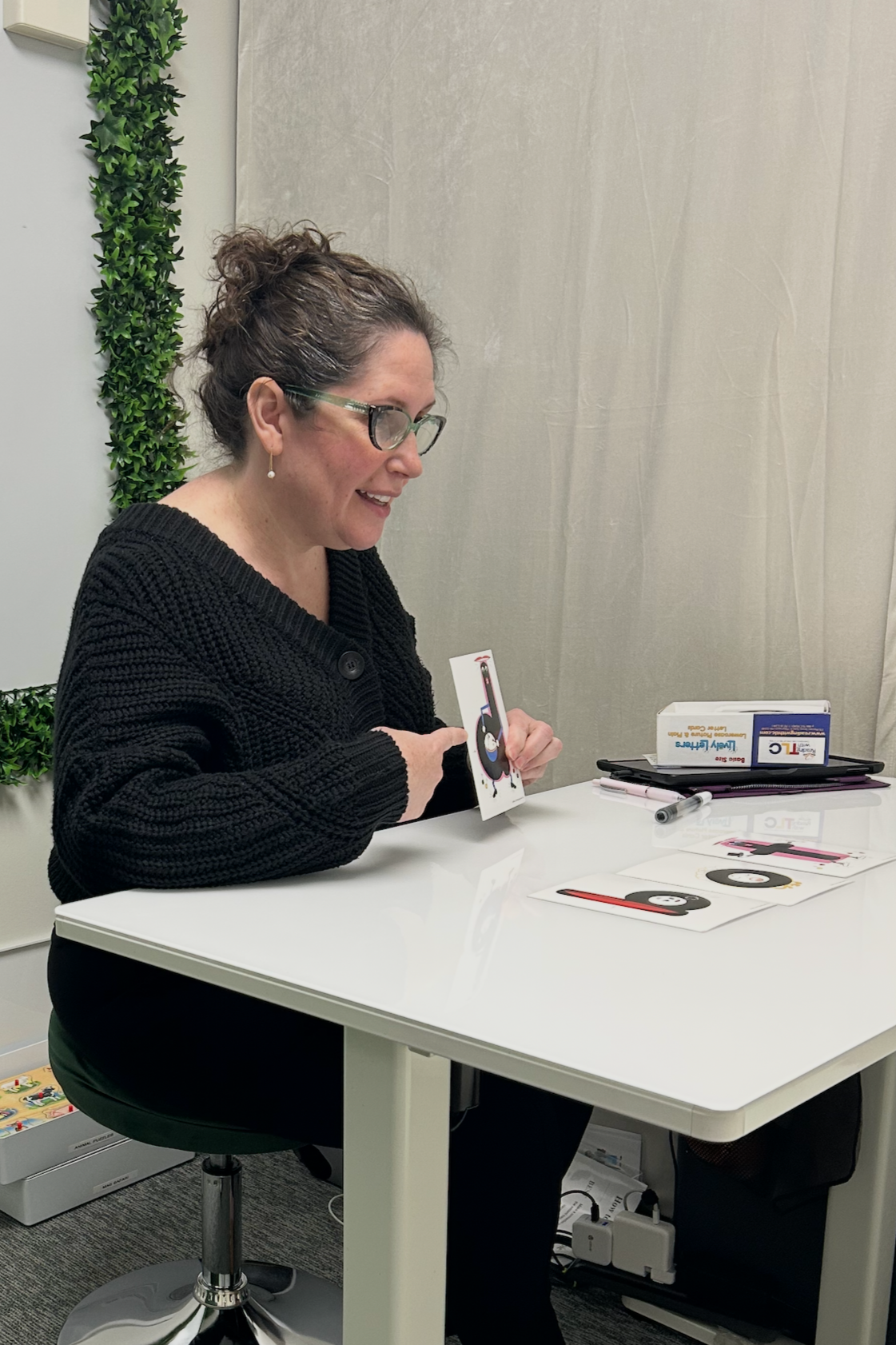
We use SPELL-Links, a modern, evidence-based, linguistic phonics program
This sounds-first approach builds on a child’s strengths for more efficient learning.
“We go there for social skills and reading since my son is AuDHD. Ellen is incredibly smart, gets how everything connects together, and is very ‘real’ with him, which he appreciates. He doesn’t fight me on going like he did at the last place. He is so much more confident than he used to be. Best of all, she makes getting reimbursed with insurance so easy.”

-
Because dyslexia is common, it helps to know the signs early.
Early signs can appear as early as preschool and may include:
Difficulty with language learning and speech clarity
Difficulty learning letter names and sounds
Trouble rhyming or identifying beginning sounds
Strong storytelling skills but difficulty matching sounds to letters
In older children, signs often look like:
Difficulty sounding out unfamiliar words
Slow, effortful reading
Persistent spelling errors
Strong verbal skills but weak decoding
Reading that relies on memorization rather than sounding out
Dyslexia is a language-based learning difference that affects how the brain processes written words. It is not caused by low intelligence — and it is not a motivation issue.
-
Yes. Spoken and written language both rely on the brain’s ability to hear, recognize, organize, and mentally manipulate speech sounds — this is phonological awareness.
Children who have difficulty clearly producing speech sounds often struggle with phonological awareness.
Phonological awareness (which includes phonemic awareness) is our ability to think about the sounds and syllables that make up words. It underlies all reading and spelling skills. Unfortunately, it is often addressed briefly, then set aside too soon.
However, because we understand speech sounds at a whole other level, we incorporate phonological awareness throughout lessons for maximum benefit, faster progress, and exceptional academic success. That’s the speech-language-literacy advantage.
-
All structured literacy programs help children break written words into letters and sounds. They do this in a clear and systematic way.
But, there are different structured literacy programs out there and they vary in approach and what they include.
A language-based approach includes the fundamental speech sound and oral language skills that underlie and support all reading and writing skills. Some programs skip this step.
Goals include:
— True word reading, not guessing
— Accurate spelling
— Reading fluency
— Reading comprehension
— Written composition“If you’re not reading and writing language, what are you reading and writing?” — Ellen McSpadden, MA, CCC-SLP, CAS
-
Orton-Gillingham (OG) approaches are often cited as the gold standard in literacy instruction. The model has been around for a long time — and newer research has given us better options.
In short, OG programs introduce letters and teach the sounds they represent. That seems good, but our spelling system is messy — and starting with letters usually means you’re starting with a child’s weakness.
Luckily, modern technological advances and the research that followed gave us a much better understanding of how the brain actually learns to read. As a result, modern speech-to-print and linguistic phonics approaches were born.
Speech-to-print methods start with the spoken sound and teach how they’re represented by letters. Because the brain is naturally wired to process information that way, it’s often an easier, more efficient method of teaching.
Linguistic phonics is a specific type of speech-to-print approach that encompasses the logic behind when various spellings are used for a specific sound.
Because speech-to-print and linguistic phonics approaches are based on how the brain actually learns to read and spell — and because they fully integrate phonological awareness, spelling, metacognition, and executive functions into every lesson — the research has shown that learning is easier, faster, and more applicable to real-life literacy experiences. Kids simply do better.
-
Yes — but if a child struggles to understand spoken language, especially longer or more complex explanations, they will almost certainly struggle with written language too.
Therefore, attention to things like multiple-meaning words, suffixes, and complex sentences — in both spoken and written language — is a critical component in quality reading and spelling instruction.
FAQs About Dyslexia, Dysgraphia, and Help for Reading and Spelling
The road to reading & writing is long, but it doesn’t need to be bumpy.
Schedule a free reading and spelling consultation to smooth the road ahead.
Not sure? Have questions?
Start with a free 30-minute consultation.
Bring your child, meet Ellen, talk through your concerns, and get help deciding the best next step. Available in the office or online.
Parent Resources for Reading and Literacy Development
Understanding why reading is difficult can help families choose the right kind of support. If your child is bright but struggling with reading, these articles explain the underlying skills involved in literacy and the approaches that often help children become more confident readers.
Why Bright Kids Sometimes Struggle With Reading — And What Actually Helps
Learn how reading depends on decoding, spelling, and language skills, and why bright students can still experience reading difficulties.
Is It Normal for a 7-Year-Old to Struggle With Reading?
Explains what typical reading development looks like around age seven and how to recognize when a child may benefit from additional reading help.
Signs of Dyslexia in Bright Children
Describes common signs of dyslexia that can appear even in bright, capable children and how linguistic phonics can help.
Six Signs Your Child May Need Reading Help (Even If They’re Bright)
Highlights six common signs that a child may benefit from additional reading help, even when they are bright and doing well in other areas.
Why Your Child Can’t Sound Out Words When Reading
Explains why some bright children struggle to sound out words when reading and how language-based instruction can strengthen decoding skills.
What Is Structured Literacy? A Parent-Friendly Guide on Why It Helps Many Struggling Readers
A parent-friendly explanation of structured literacy and why explicit reading instruction helps struggling readers.
Speech-to-Print vs Traditional Phonics: Two Ways Reading Is Taught
Explore two phonics frameworks and how they help children connect spoken language to written words.