Why Bright Kids Sometimes Struggle With Reading — And What Actually Helps
A child can be intelligent, curious, and capable — and still struggle with reading and spelling. Understanding why is the first step toward helping things click.
Why a bright child may struggle with reading
One of the most confusing experiences for parents is realizing that their child is clearly bright — but reading feels harder than it should.
These children are often curious, thoughtful, and capable in many areas of school. They may understand complex ideas when listening or talking. Yet, when it comes to reading, something just doesn’t click.
Parents frequently ask:
If my child is smart, why is reading still such a struggle?
The answer is that reading is a surprisingly complex skill – and one that the brain isn’t naturally built to do.
Reading is based on several underlying skills
Reading comprehension depends on two major abilities working together:
Decoding
The ability to recognize and pronounce written words — it requires an understanding of how letters and letter combinations represent spoken sounds.
Language comprehension
The everyday language skills we use to listen and speak — it includes vocabulary, grammar, sentence structure, and how ideas connect in conversation.
In other words, a child must both read the words on the page and understand the language those words represent.
If either of these areas is weak, reading can become frustrating and comprehension can become impossible even for very intelligent children. This is why a bright child may:
Understand stories when listening, but struggle to read those same stories independently
Have a wonderful vocabulary, but seemingly guess at words while reading
These struggles are often signs that the underlying reading skills were never fully established or connected to the larger system of language.
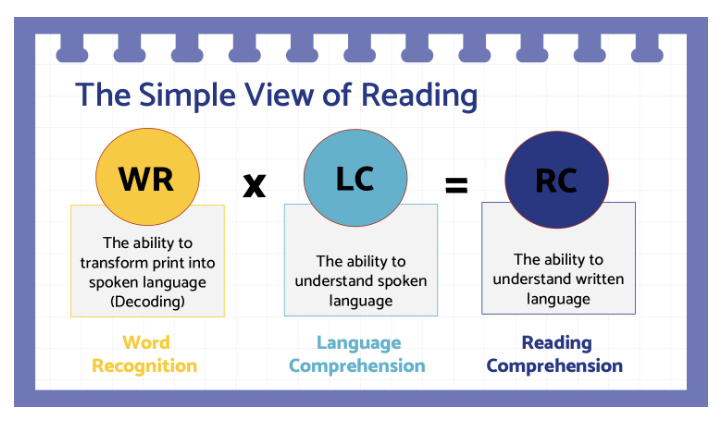
The Simple View of Reading
Hanover County Public Schools. (n.d.). Literacy and Hanover County Public Schools [Webpage Literacy and Hanover County Public Schools]. Retrieved March 13, 2026, from https://hcps.us/parents_students/literacy_and_hanover_county_public_schools
When reading instruction doesn’t fully click
Many children are exposed to reading instruction in school, but exposure alone does not always build the deeper skills and connections children need.
Some students learn to memorize words or rely on context clues. This can work for a while, especially in early grades.
But, as texts become more complex, those strategies become less effective.
Parents may begin noticing that their child:
avoids reading
struggles with spelling
reads slowly or has trouble sounding out words when reading
becomes frustrated with longer paragraphs or books
When this happens, the issue is rarely motivation or intelligence. More often, the child needs more explicit instruction in how spoken language connects to written language.
Understanding different approaches to teaching reading
Not all reading instruction is the same.
Some approaches focus heavily on memorizing written words. Others focus on developing a large inventory of rules to help break them down. More modern approaches begin with the sounds we produce with our mouths and tie them to the written letters that represent them.
Many researchers and reading specialists recommend structured literacy approaches, which teach reading skills in a clear and systematic way.
Structured literacy instruction typically includes:
phonological awareness
sound-letter relationships
decoding strategies
spelling
writing
word structure
These elements help children understand the system behind written language instead of relying on guesswork.
Why spelling and language must be part of reading intervention
Many parents are surprised to learn that spelling instruction should be included in reading support.
This is because spelling offers the best bang-for-your-buck when it comes to literacy instruction. When children are taught to read, they learn to read. When children are taught to spell, they learn to read and spell.
Spelling is also a more effective way to teach how we change the meaning of words by adding or removing prefixes and suffixes – children learn how words are built by constructing and deconstructing them.
When children practice producing words (not just recognizing them) they develop a deeper understanding of the patterns that govern written language – strengthening a wide variety of language and literacy skills at the same time.
Regarding language, the Language Literacy Network pictured below shows that reading and spelling are not isolated skills. Instead, they are made up of many smaller skills that gradually integrate and strengthen over time.
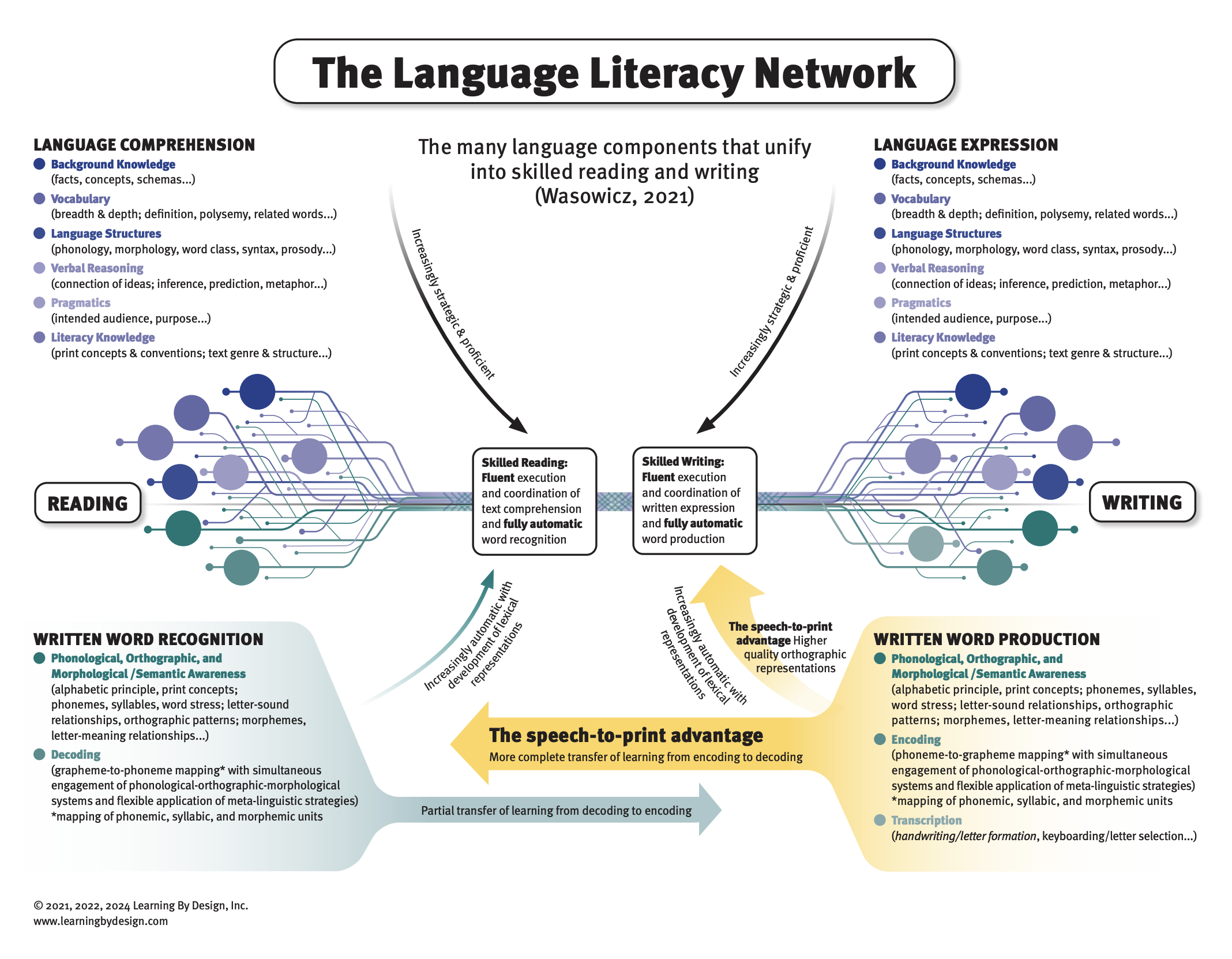
The Language Literacy Network
Wasowicz, J. (2021). The Language Literacy Network. Learning By Design, Inc. www.learningbydesign.com
Different phonics frameworks
Even phonics-based programs can differ in how they teach reading.
Some programs use print-to-speech instruction, where children begin with letters and learn the sounds those letters represent.
Other programs use speech-to-print instruction, where children begin with spoken sounds and then learn how those sounds are represented in print.
For struggling readers, starting with spoken language usually helps them make the connection between speech and print faster and easier. It also teaches them the flexibility needed to anticipate and accept “rule breakers.”
When extra support or tutoring for reading and spelling may help
When reading difficulties persist despite strong effort, additional instruction can make a significant difference. With clear, systematic teaching, many children begin to understand how spoken language connects to written words — allowing reading to become more predictable and manageable instead of frustrating.
Parents may want to explore additional reading support if their child:
is bright but avoids reading
guesses at unfamiliar words
struggles with spelling
reads slowly or with effort
becomes frustrated with longer texts
These challenges are common and often respond very well to targeted instruction.
Reading help and tutoring for kids in Haddonfield, NJ
For families looking for reading tutoring or literacy support in Haddonfield, NJ and the surrounding South Jersey area, the most important first step is understanding which skills are actually driving the difficulty.
When those underlying skills are clearly identified and taught explicitly using language-based instruction, reading often becomes far more predictable and manageable for children.
At Cheerful Chatter, we specialize in targeted reading and spelling support that helps children and teens understand how sounds, letters, and spelling patterns work together to build confident reading.
All families are invited to schedule a free, in-person reading and spelling consultation to talk through their concerns and explore the best next steps.
Outside the South Jersey area? We also offer teletherapy-based literacy services to support children and teens throughout New Jersey, Pennsylvania, and Georgia.
Frequently Asked Questions About Reading Struggles
-
Many children guess words when they have not fully learned how sounds connect to letters in written language. When decoding skills are weak, children often rely on guessing instead of sounding out unfamiliar words.
-
This usually means the child’s language comprehension is strong but decoding skills need support. The child understands the ideas but has difficulty reading the words independently.
-
Children often avoid activities that feel difficult or frustrating. When reading becomes easier and more predictable, many children regain confidence and begin enjoying books again.
-
Most struggling readers benefit from structured literacy instruction that explicitly teaches sound-letter relationships, decoding, spelling, and word structure. Speech-to-print approaches have the advantage due to their natural alignment with existing language processes.
-
Yes. Spelling strengthens understanding of how words are constructed, which supports both reading and writing development.